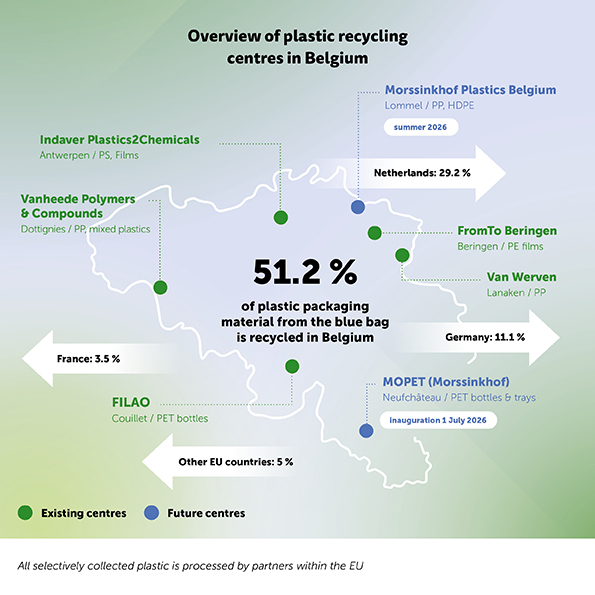
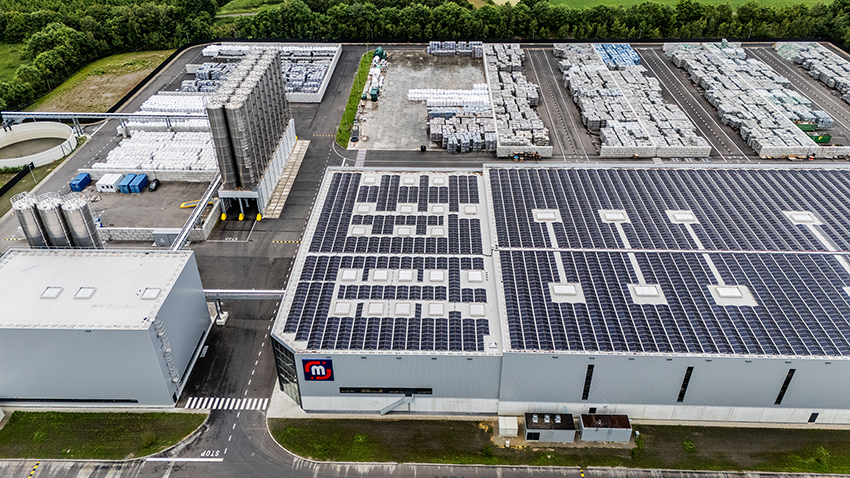

1 July 2026 saw the official opening of MOPET, Morssinkhof Plastics’ brand-new recycling plant in Neufchâteau. This is the fifth recycling plant in Belgium to have been built specifically for packaging from the blue bag. And it’s also the best proof that investing in local recycling really does pay off.
The new factory represents an investment of EUR 68.5 million and will create at least 90 direct jobs. The intermunicipal organisation Idelux, which is responsible for waste collection in the province of Luxembourg, is co-investing in the project.
28,000 tonnes of additional capacity
MOPET will process 28,000 tonnes of PET packaging from the PMD bag every year. This project is unique in that it recycles not only transparent PET bottles, but also opaque PET bottles (including those used for milk) and PET trays. Recycling the last two product groups is a lot more complex. Thanks to advanced technologies, MOPET recycles them into food-safe r-PET, which can be used as a raw material for new packaging.
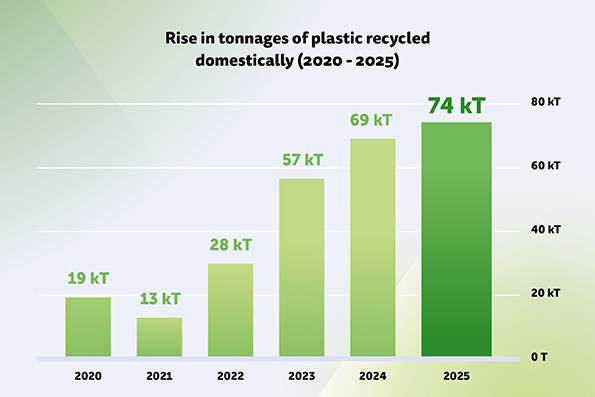
The new plant is part of a clear move towards more local recycling of the packaging that Fost Plus collects from the Belgian public. Six times as much plastic packaging was processed in Belgium in 2025 as four years earlier, rising from 13,463 to 74,236 tonnes. This means that Fost Plus now recycles more than half of the plastic packaging from the PMD bag in Belgium.
A deliberate strategy
This development did not come about by chance. It’s the result of a deliberate strategy. In 2020 and 2021, Fost Plus issued six calls for proposals for the recycling of plastic streams from the PMD bag. The aim was to encourage industrial investment and expand domestic capacity by means of long-term contracts with guaranteed volumes.
That strategy is now paying off. Five plants are already fully operational today and a sixth – also owned by Morssinkhof, in Lommel – is due to start up shortly. Meanwhile, a great deal of capacity has been lost at European level in recent years.
Local processing offers a number of clear advantages. It contributes to the local economy and employment, and processing becomes more sustainable as it requires less transport. Furthermore, there is greater transparency regarding the final destination of the materials collected, and it is easier to check whether processing is carried out in accordance with best practices.
Creating opportunities for innovation
But there are less obvious benefits, too. Close working relationships with recycling partners enable to find sustainable solutions for more complex materials, as illustrated by the example of MOPET. Items that are recyclable in theory often require further research and extensive testing in practice. This is much easier when the physical distance involved isn’t too great.
In addition, the proximity of the facilities also offers a great many opportunities for groundbreaking innovations, such as chemical recycling. Today, for example, packaging can already be found in Colruyt’s stores that uses materials from Indaver’s Plastics2Chemicals plant in the Port of Antwerp. A major breakthrough for this technology, which makes it possible to turn heavily contaminated packaging, such as polystyrene yoghurt pots, back into food-safe materials.
Recycled content for local producers
Finally, the recycled materials are also made available to local producers. The example of FILAO in Charleroi speaks volumes in this regard. PET bottles collected by Fost Plus from Belgian households are recycled into new bottles, most of which are destined for Belgian supermarkets. The factory is a joint venture between Veolia and Sources-Alma, which produces bottled water under private label for a number of major retailers.
This also offers prospects for the future: the new European PPWR regulation requires the use of recycled content in most plastic packaging from 2030 onwards, which will lead to a huge increase in demand for recycled materials. The local availability of these materials – including for more complex packaging – could then become a significant competitive advantage for Belgian companies.
The conclusion is clear. By investing in local recycling, we are able to close the loop in the most sustainable way possible and make a significant contribution to the Belgian economy. Sometimes it really does pay to go against the grain.