

Solar panels remain a strong symbol of the energy transition. They generate green energy for many years and contribute to a low-carbon society. But their role does not end at the end of their lifetime. On the contrary, this is where a new chapter begins – one in which materials are recovered and products can be given a second life.
Strong growth in collection despite a slowing market
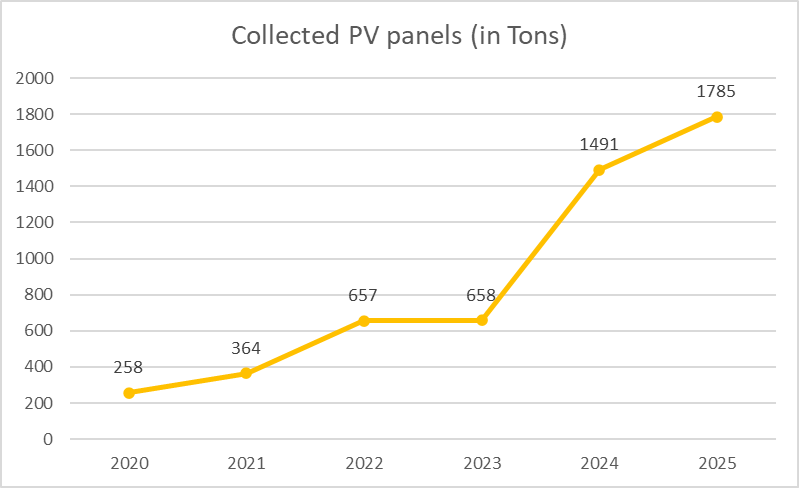
This evolution is clearly visible in practice. In 2025, PV CYCLE Belgium collected 1,785 tons of solar panels, representing around 90,000 panels. This marks a 20% increase compared to 2024, which was already a record year.
Notably, this growth occurs in a market that is slowing down, with around 2 million panels placed on the market annually. The explanation lies in repowering: first-generation panels are increasingly being replaced by newer models that are more efficient and more affordable.
Preparing for rising volumes
The result is clear: volumes of end-of-life solar panels are increasing rapidly and will continue to grow in the coming years. Collection and treatment are therefore no longer an afterthought, but a key component of the energy transition.
For PV CYCLE Belgium, the challenge is to anticipate and prepare for these growing volumes, both in collection and processing. Recycling technologies are available, and market players are ready to invest in additional capacity at the right time.
Also focusing on reuse
At the same time, we are looking beyond recycling. Reuse offers additional opportunities. That is why we are actively contributing to the development of an international reference document defining the tests required to assess whether panels can still operate safely and efficiently. The aim is to create a reliable framework for reuse.
Moving forward together with Round
Together with the partners within Round, we continue to build this future. Because a sustainable energy transition is only complete when end-of-life management is equally sustainable.